Strategy
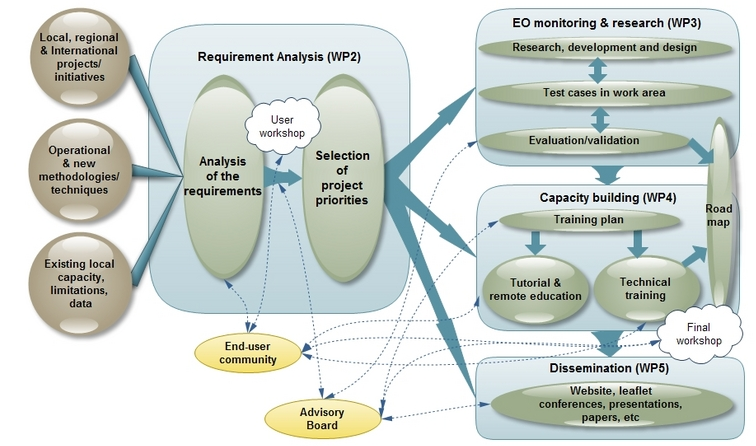
The strategy to achieve good project roll-out and completion of the project goals is based on the execution of 5 Work Packages (WP). The second Work Package, ‘Requirement Analysis’ is crucial to achieve fixed objectives and to assure their correspondence with the user’s needs. The WP 2 defines precisely, specific tasks for the WP’s 3 and 4. This will be done in the frame of the budget, capacity of project partners and user’s needs.
General strategy : project deployment
Management of the project (WP1)
The project coordination, realized by EUROSENSE, is executed by the project manager who acts as a centralist for all project activities. This Work Package taking place from the beginning to the end has to ensure the realization of objectives defined for each WP and, if necessary, refocus activities so that they actually meet the fixed objectives.
Requirement Analysis (WP2)
The second Work Package foresees to collect information to realize a requirement analysis of existing needs in the project’s frame. On one hand, local, regional and international projects and initiatives will be listed together with existing operational methodologies and techniques. On the other hand, existing local data and gaps in capacities will be analyzed.
Local partners will consult a panel of final users in the target to understand, e.g.:
• which are the needs in terms of monitoring (e.g. different types of forests with different biomasses);
• on which important local process the monitoring system should rely;
• which are the challenges and what’s already done in the country, especially to measure carbon.
All this information, once analyzed and after selection of the project’s priorities during the user workshop, must result in clear recommendations which will serve as guidelines for the project. These guidelines will fix two or three specific technical aspects on which to focus during the WP3, they will also highlight concrete points for capacity building.
Technical aspects development (WP 3)
The main target of the WP3 is to develop, test and adapt specific technical aspects which could help to establish a monitoring system by remote sensing. These techniques must, on one hand, be adapted to local conditions and international requirements. On the other hand they must be used and implemented concretely by national centers so they can fulfill their obligations under REDD and accounting for carbon emissions.
Capacity building (WP 4)
Depending on missing capacities and key actors identified during the requirement analysis, the regional cooperation program should be reinforced by an ad-hoc training plan. This training plan is the object of the forth WP, it will be given in two extensive sessions during which the key actors, defined during the requirement analysis, will be present.
Dissemination (WP 5)
Finally, the fifth WP foresees the preparation and the dissemination of the project’s results.
Support Central Africa in Earth Observation driven forest monitoring for REDD
NEWS
04/01/2012 - A REDDiness poster was presented in Oxford during the international conference on Climate change, deforestation and the future of African rainforests .
28/11 to 10/12/2011 - REDDiness project presented at the 17th Conference of the Parties (COP 17) in Durban, South Africa. REDDiness was discussed during the Side Event organized by the REDD National Coordination of the Republic of Congo.
25/10/2011- Progress meeting took place in Kinshasa on the 20st and 24th October 2011.
05/06/2011 - Eurosense attended and presented in the 31st EARSeL Symposium (1st Workshop on Forestry) on the 2nd and 3rd of June 2011.
05/06/2011 - REDDiness project card published in the "Space Research - A European Journey (Space research projects under the 7th Framework Programme for research)". Available here, page 58.
14/05/2011 - REDDiness project presented on the FP7 Space conference in Budapest on the 12th and 13th of May 2011..
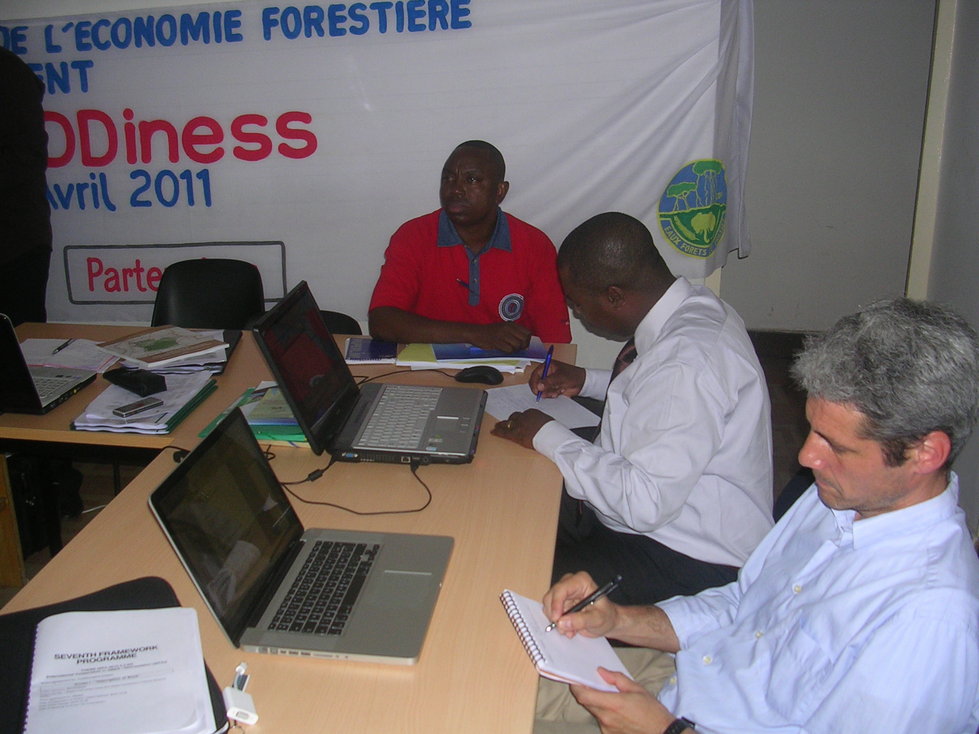
03/05/2011 – REDDiness kick-off meeting in Brazzaville on the 1st and 2nd May.
15/04/2011 - REDDiness presented in the magazines EOMag of EARSC. Available here
This project is partially funded by the European Commission Seventh Framework Programme. The project reflects only the author’s views and the Community is not liable for any use that may be made of the information contained herein.