Context
The problem
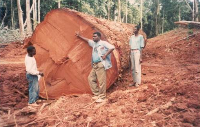
Deforestation rates around the world are very high. The FAO estimates that about 13 million hectares of forest are cut annually and converted to another land use (FRA, 2010). Unfortunately, very few countries estimate their actual deforestation rate. These estimations are rarely based on regular evaluations or on accurate methodology which results in a high degree of uncertainty.
The problem
Deforestation rates around the world are very high. The FAO estimates that about 13 million hectares of forest are cut annually and converted to another land use (FRA, 2010). Unfortunately, very few countries estimate their actual deforestation rate. These estimations are rarely based on regular evaluations or on accurate methodology which results in a high degree of uncertainty.
Support Central Africa in Earth Observation driven forest monitoring for REDD
This project is partially funded by the European Commission Seventh Framework Programme. The project reflects only the author’s views and the Community is not liable for any use that may be made of the information contained herein.


PROJECT OUTCOMES
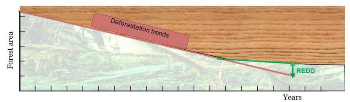
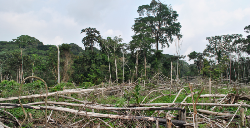
Moreover, deforestation is not the only factor to take into account. We must also consider changes in the composition, the structure and the health of the forest ecosystems, i.e. the degradation of forests. It is caused by different factors, including an overexploitation of forest, pests, diseases or fire forests. Deforestation doesn’t result in a forest loss itself but is often the first step of a process leading ultimately to real deforestation.
Given that 12-15% of greenhouse gases emissions comes from anthropogenic deforestation, REDD (Reducing Emissions from Deforestation and Forest Degradation) was initiated at the Conference on Climate in Montreal in 2006 (UNFCCC, 2009). The basic principle of REDD is to reward efforts of developing countries so they can reduce their greenhouse gases from deforestation and forest degradation.
Given that 12-15% of greenhouse gases emissions comes from anthropogenic deforestation, REDD (Reducing Emissions from Deforestation and Forest Degradation) was initiated at the Conference on Climate in Montreal in 2006 (UNFCCC, 2009). The basic principle of REDD is to reward efforts of developing countries so they can reduce their greenhouse gases from deforestation and forest degradation.
Conservation of African forests is part of the solution. But knowing that in Africa the deforestation rates aren’t so high than in South-America for example, an extension of the REDD initiative towards REDD+ is important. In addition to forest degradation and deforestation, it also takes into account efforts towards a sustainably management of the forest, forest conservation and an increase of the carbon stocks (reforestation).
To enable developing countries to obtain such financial compensation, an operational monitoring system should be established. Remote sensing data are an essential tool to cover these areas.
Moreover, REDD faces a certain number of technical challenges, especially the establishment of effective systems, allowing a correct evaluation of carbon emissions from forests and of robust references of emission levels.
More info on the subject can be found in following documents. The first one is a detailed REDDiness outline on the context (in French, with an English summary).
To enable developing countries to obtain such financial compensation, an operational monitoring system should be established. Remote sensing data are an essential tool to cover these areas.
Moreover, REDD faces a certain number of technical challenges, especially the establishment of effective systems, allowing a correct evaluation of carbon emissions from forests and of robust references of emission levels.
More info on the subject can be found in following documents. The first one is a detailed REDDiness outline on the context (in French, with an English summary).