Structure of the project
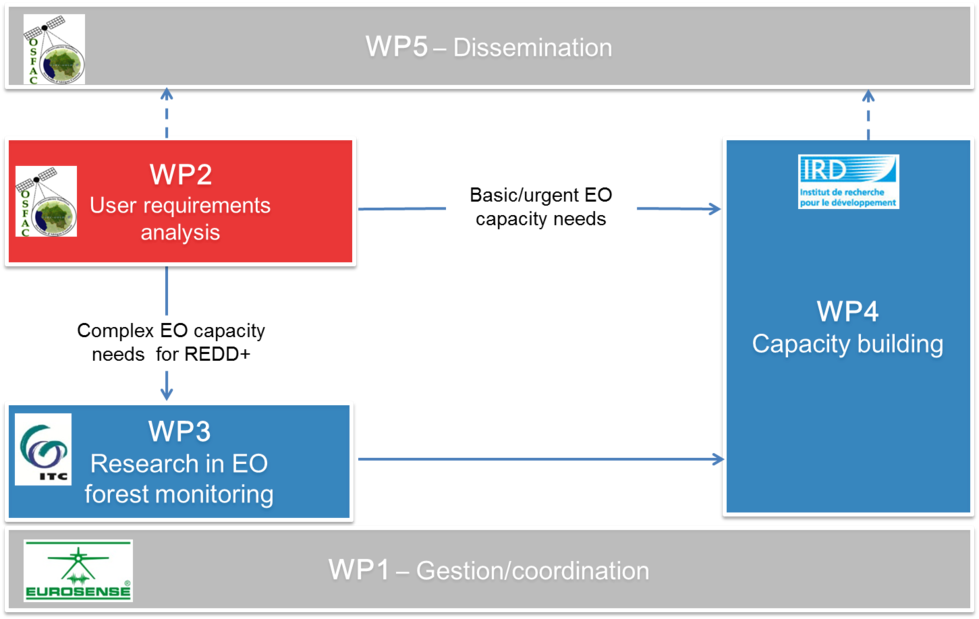
To achieve a good project roll-out and completion of the project goals, the project is divided in 5 Work Packages (WP). The second Work Package, ‘Requirement Analysis’ is crucial, as it defines precisely the tasks for the WP’s 3 and 4.
Management of the project (WP1) - The project coordination, realized by EUROSENSE, is executed by the project manager who acts as a centralist for all project activities. This Work Package taking place from the beginning to the end has to ensure the realization of objectives defined for each WP and, if necessary, refocus activities so that they actually meet the fixed objectives.
Requirement Analysis (WP2)- The second Work Package foresees to collect information to realize a requirement analysis of existing needs in the project’s frame. On one hand, local, regional and international projects and initiatives will be listed together with existing operational methodologies and techniques. On the other hand, existing local data and gaps in capacities will be analyzed. All this information must result in clear recommendations which will serve as guidelines for the project. This survey confirmed that REDD+ negotiations are still at an initial stage in the considered countries. Both countries have limited technical and human resources to develop a forest monitoring system inline with UNFCCC requirements.The final deliverable on this WP can be found here.
Technical aspects development (WP 3) - The main target of the WP3 is to develop, test and adapt specific technical aspects which could help to establish a monitoring system by remote sensing. Based on the results of WP2, it was decided to focus on the monitoring of forest degradation. Important here is that the developments, on one hand, must be adaptable to local conditions and international requirements and on the other hand must be usable and implementable by national centers so they can fulfill their obligations under REDD+ and accounting for carbon emissions.
Capacity building (WP 4)- Based on the missing capacities and key actors identified during the requirement analysis (WP2), the regional cooperation program will be reinforced by an ad-hoc training plan. In this context, two intensive sessions are/will be given. Associated with these technical training sessions, the project built and improved the technical local expertise through the participation to fieldwork. Click here for online available training material in REDDiness.
Dissemination (WP 5)- Finally, the fifth WP foresees the preparation and the dissemination of the project’s results. Following activities were already done within REDDiness:
To achieve a good project roll-out and completion of the project goals, the project is divided in 5 Work Packages (WP). The second Work Package, ‘Requirement Analysis’ is crucial, as it defines precisely the tasks for the WP’s 3 and 4.
Management of the project (WP1) - The project coordination, realized by EUROSENSE, is executed by the project manager who acts as a centralist for all project activities. This Work Package taking place from the beginning to the end has to ensure the realization of objectives defined for each WP and, if necessary, refocus activities so that they actually meet the fixed objectives.
Requirement Analysis (WP2)- The second Work Package foresees to collect information to realize a requirement analysis of existing needs in the project’s frame. On one hand, local, regional and international projects and initiatives will be listed together with existing operational methodologies and techniques. On the other hand, existing local data and gaps in capacities will be analyzed. All this information must result in clear recommendations which will serve as guidelines for the project. This survey confirmed that REDD+ negotiations are still at an initial stage in the considered countries. Both countries have limited technical and human resources to develop a forest monitoring system inline with UNFCCC requirements.The final deliverable on this WP can be found here.
Technical aspects development (WP 3) - The main target of the WP3 is to develop, test and adapt specific technical aspects which could help to establish a monitoring system by remote sensing. Based on the results of WP2, it was decided to focus on the monitoring of forest degradation. Important here is that the developments, on one hand, must be adaptable to local conditions and international requirements and on the other hand must be usable and implementable by national centers so they can fulfill their obligations under REDD+ and accounting for carbon emissions.
Capacity building (WP 4)- Based on the missing capacities and key actors identified during the requirement analysis (WP2), the regional cooperation program will be reinforced by an ad-hoc training plan. In this context, two intensive sessions are/will be given. Associated with these technical training sessions, the project built and improved the technical local expertise through the participation to fieldwork. Click here for online available training material in REDDiness.
Dissemination (WP 5)- Finally, the fifth WP foresees the preparation and the dissemination of the project’s results. Following activities were already done within REDDiness:
Support Central Africa in Earth Observation driven forest monitoring for REDD
This project is partially funded by the European Commission Seventh Framework Programme. The project reflects only the author’s views and the Community is not liable for any use that may be made of the information contained herein.



PROJECT OUTCOMES