Side Event
During the 17th Conference of the Parties (COP 17) of the United Nations Framework Convention on Climate Change, from the 28th of November to 10th of December, a day called “REDD+ day of the Republic of Congo” was organized by the REDD National Coordination. This day, the 6th of December, was supervised by Mister Henri DJOMBO, Minister of Sustainable Development, Forest Economy and Environment. Its goal was to inform the international opinion of the countries’ progress in the field of REDD+, forest conservation and sustainable management.
REDDiness project has been mentioned as a supporting initiative in the REDD plans of the Republic of Congo. Information about REDDiness, first outputs and focus for further EO (Earth Observation) monitoring actions, can be seen on the poster attached.
Preserving African forest contributes to Global climate change challenge. Earth Observation (EO) techniques are essential in monitoring forest changes and supporting REDD (Reducing Emissions from Deforestation and forest Degradation) negotiations for climate change mitigation. The REDDiness approach refers to existing projects and initiatives in the Congo Basin. REDDiness responds to the EC call for increased collaboration between Africa and Europe within Specific International Cooperation Action (SICA).
A quantitative survey has been carried out in Republic of Congo and Gabon to measure awareness and interest in EO-based products. Eight survey participants among 26 were identified as most relevant for the in-depth quantitative analysis based on their technical understanding defined by two criteria: (i) knowledge of EO techniques, (ii) completeness and coherence of responses. Survey results identify the expected EO techniques for REDD (see figure below) and show that skills and technical resources regarding the use of EO software and data are very limited. The low level of knowledge about REDD and MRV implementation confirms the need for capacity building on REDD/REDD+ and forest monitoring in the countries involved.
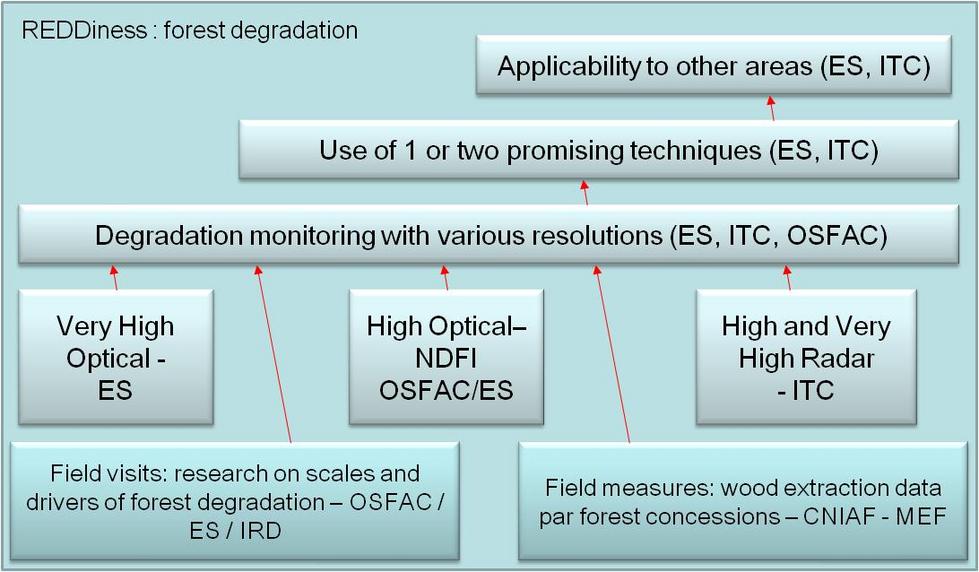
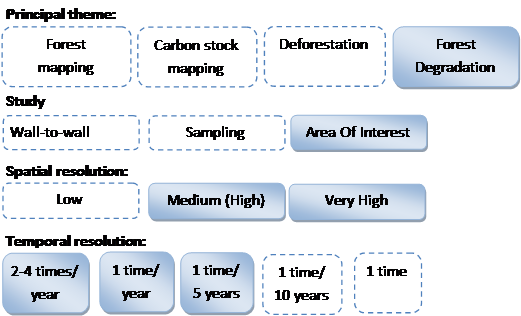
The focus on “forest degradation” for REDDiness is the outcome of a detailed decision process in the consortium. The figure summarizes the relevant choices to be made by REDD projects (or countries) when deciding on starting up an earth observation strategy. The agreed aim of REDDiness is to evaluate the effectiveness of different types of satellite imagery in detecting and monitoring forest degradation. Such an evaluation is urgently needed given: 1) the importance of forest degradation in REDD, 2) the difficulty to assess forest degradation due to spatial size and pattern, 3) the limited time frame in which to detect degradation (quick regeneration) and 4) the frequent cloud cover in both countries limiting optical image acquisition.
During the 17th Conference of the Parties (COP 17) of the United Nations Framework Convention on Climate Change, from the 28th of November to 10th of December, a day called “REDD+ day of the Republic of Congo” was organized by the REDD National Coordination. This day, the 6th of December, was supervised by Mister Henri DJOMBO, Minister of Sustainable Development, Forest Economy and Environment. Its goal was to inform the international opinion of the countries’ progress in the field of REDD+, forest conservation and sustainable management.
REDDiness project has been mentioned as a supporting initiative in the REDD plans of the Republic of Congo. Information about REDDiness, first outputs and focus for further EO (Earth Observation) monitoring actions, can be seen on the poster attached.
Preserving African forest contributes to Global climate change challenge. Earth Observation (EO) techniques are essential in monitoring forest changes and supporting REDD (Reducing Emissions from Deforestation and forest Degradation) negotiations for climate change mitigation. The REDDiness approach refers to existing projects and initiatives in the Congo Basin. REDDiness responds to the EC call for increased collaboration between Africa and Europe within Specific International Cooperation Action (SICA).
A quantitative survey has been carried out in Republic of Congo and Gabon to measure awareness and interest in EO-based products. Eight survey participants among 26 were identified as most relevant for the in-depth quantitative analysis based on their technical understanding defined by two criteria: (i) knowledge of EO techniques, (ii) completeness and coherence of responses. Survey results identify the expected EO techniques for REDD (see figure below) and show that skills and technical resources regarding the use of EO software and data are very limited. The low level of knowledge about REDD and MRV implementation confirms the need for capacity building on REDD/REDD+ and forest monitoring in the countries involved.
The focus on “forest degradation” for REDDiness is the outcome of a detailed decision process in the consortium. The figure summarizes the relevant choices to be made by REDD projects (or countries) when deciding on starting up an earth observation strategy. The agreed aim of REDDiness is to evaluate the effectiveness of different types of satellite imagery in detecting and monitoring forest degradation. Such an evaluation is urgently needed given: 1) the importance of forest degradation in REDD, 2) the difficulty to assess forest degradation due to spatial size and pattern, 3) the limited time frame in which to detect degradation (quick regeneration) and 4) the frequent cloud cover in both countries limiting optical image acquisition.
Support Central Africa in Earth Observation driven forest monitoring for REDD
This project is partially funded by the European Commission Seventh Framework Programme. The project reflects only the author’s views and the Community is not liable for any use that may be made of the information contained herein.



PROJECT OUTCOMES